DECOR
Wabi sabi: the Japanese art of loving the imperfect
A bowl mended with gold, a rough clay cup, a single wild flower. Why Japan finds beauty in things that are imperfect, and how to bring that feeling home.
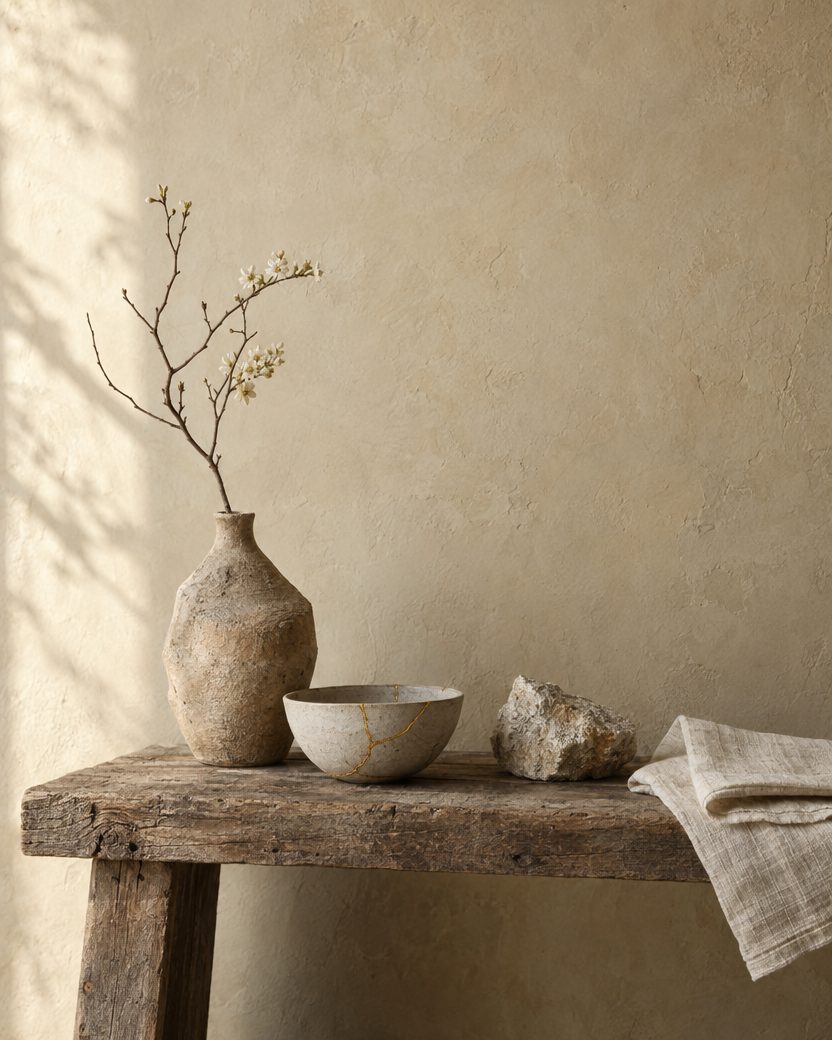
Wabi sabi is a Japanese way of seeing beauty in things that are imperfect, impermanent and incomplete. It is not a style you buy. It is a way of looking at the world, and it has shaped Japanese homes, gardens and tea for centuries.
What the words mean
Wabi is often translated as a quiet, austere beauty. Sabi suggests the patina that time leaves on things, and it is linked to the Japanese word for rust. Both words once carried a sense of loneliness, but over time they softened into something hopeful. Today wabi sabi is often summed up as wisdom in natural simplicity.
One handmade piece says more than five perfect ones.
Where it comes from
Wabi sabi grew out of the Buddhist teaching of the three marks of existence: that everything is impermanent, that life includes suffering, and that nothing has a fixed self. Accepting imperfection came to be seen as a step toward peace.
It came to life through tea. In the 1400s, the Zen priest Murata Juko changed the tea ceremony by replacing gold, jade and porcelain with simple, rough wooden and clay utensils. A century later, the tea master Sen no Rikyu built tea houses with a door so low that even the emperor had to bow to enter. He used simple vessels and preferred wild flowers for his displays.
Gold in the cracks
Kintsugi is wabi sabi you can hold. Broken pottery is mended with gold lacquer, so the crack becomes part of the bowl's story instead of something to hide.
What wabi sabi looks like
Asymmetry, roughness, simplicity and modesty, with a deep respect for natural materials and the marks of time. Japanese gardens, especially Zen rock gardens, are built from large rocks and natural materials. Bonsai trees are loved for their rough bark, deadwood and hollow trunks, because they show the years.
Why it speaks to us
Wabi sabi sits close to the heart of DYTUMRAW. A raw rock is never perfectly round. Hand thrown clay is never perfectly even. Dried flowers fade, wood weathers, and moss slowly finds every crack. We think that is exactly where the beauty is.
How to bring wabi sabi home
- Choose one handmade piece over five perfect ones. A rough clay vase or a hand shaped bowl brings more life than a shelf of matching decor.
- Let a single branch or a few wild flowers stand alone in a vase.
- Bring in raw stone and wood, and leave them as nature made them.
- Mend instead of replacing. Keep the chipped cup and give it a new life as a tiny planter.
- Leave some space. Calm needs a little emptiness.
Want help with yours?
Message us on WhatsApp